
Exercises for Flat Feet: 5 Simple Moves for a Stronger Foot Arch
 Flat feet affect women in particular. After years of wearing heels, long hours of standing at work, or following pregnancy, the arch of the foot may gradually begin to collapse. This can lead to fatigue, foot pain, swelling, and sometimes even back pain. The good news? Even in adulthood, you can improve the condition of your feet. It only takes a few minutes a day and simple exercises you can do while watching TV. We’ll show you five movements based on physiotherapy practice and share additional tips to help support your feet.
Why Exercises for Flat Feet Make Sense
Flat feet develop when the longitudinal or transverse arch of the foot collapses. The muscles and ligaments that support the arch gradually weaken, causing the foot to spread over a larger surface area with each step. The effects can be felt from the feet through the knees and up to the spine. Common triggers include wearing narrow, high-heeled shoes, excess weight, pregnancy, and a sedentary lifestyle. You can learn more about the causes and symptoms in our article on flat foot, as well as in the article Do You Think You Have Flat Foot?
If the arch collapses only under load and the foot is still able to function actively, this is referred to as so-called flexible flatfoot. It is at this stage that exercises are most effective. A 2022 meta-analysis (see source below) showed that targeted strengthening of the foot muscles can improve arch height as well as stability in individuals with flexible flatfoot.
5 Exercises for Flat Feet You Can Do at Home
1. Short Foot Exercise
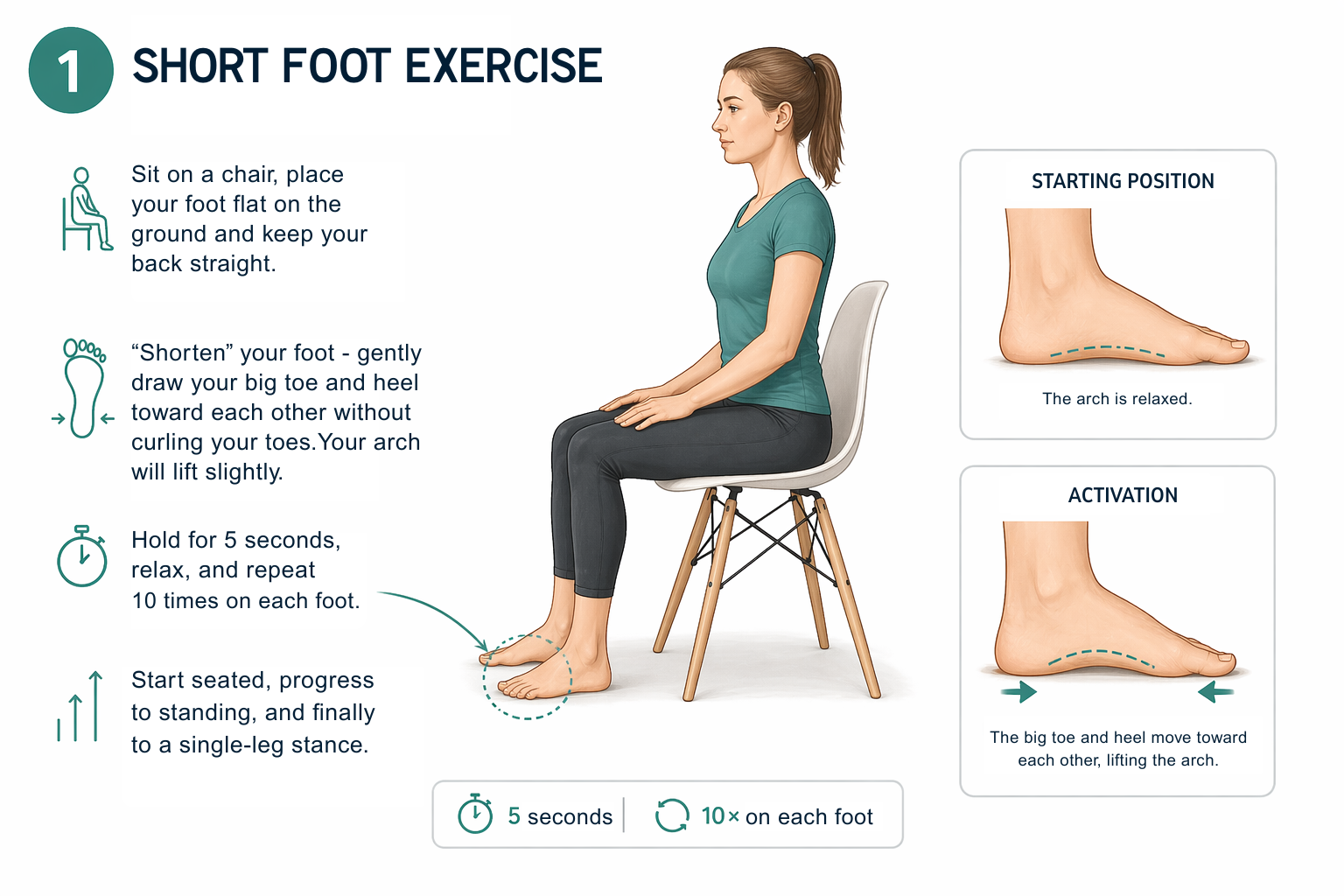
Among all the exercises, this one has the strongest scientific support. Sit on a chair with your feet flat on the ground and your back straight. Now try to “shorten” your foot by drawing the big toe and heel closer together without curling your toes. You should feel the arch gently lift.
Hold for 5 seconds, relax, and repeat 10 times on each foot. Start in a seated position, then gradually progress to standing, and finally to standing on one leg. Clinical studies show that regular short foot exercise can improve the arch and dynamic balance within just a few weeks of training.
2. Towel Scrunches
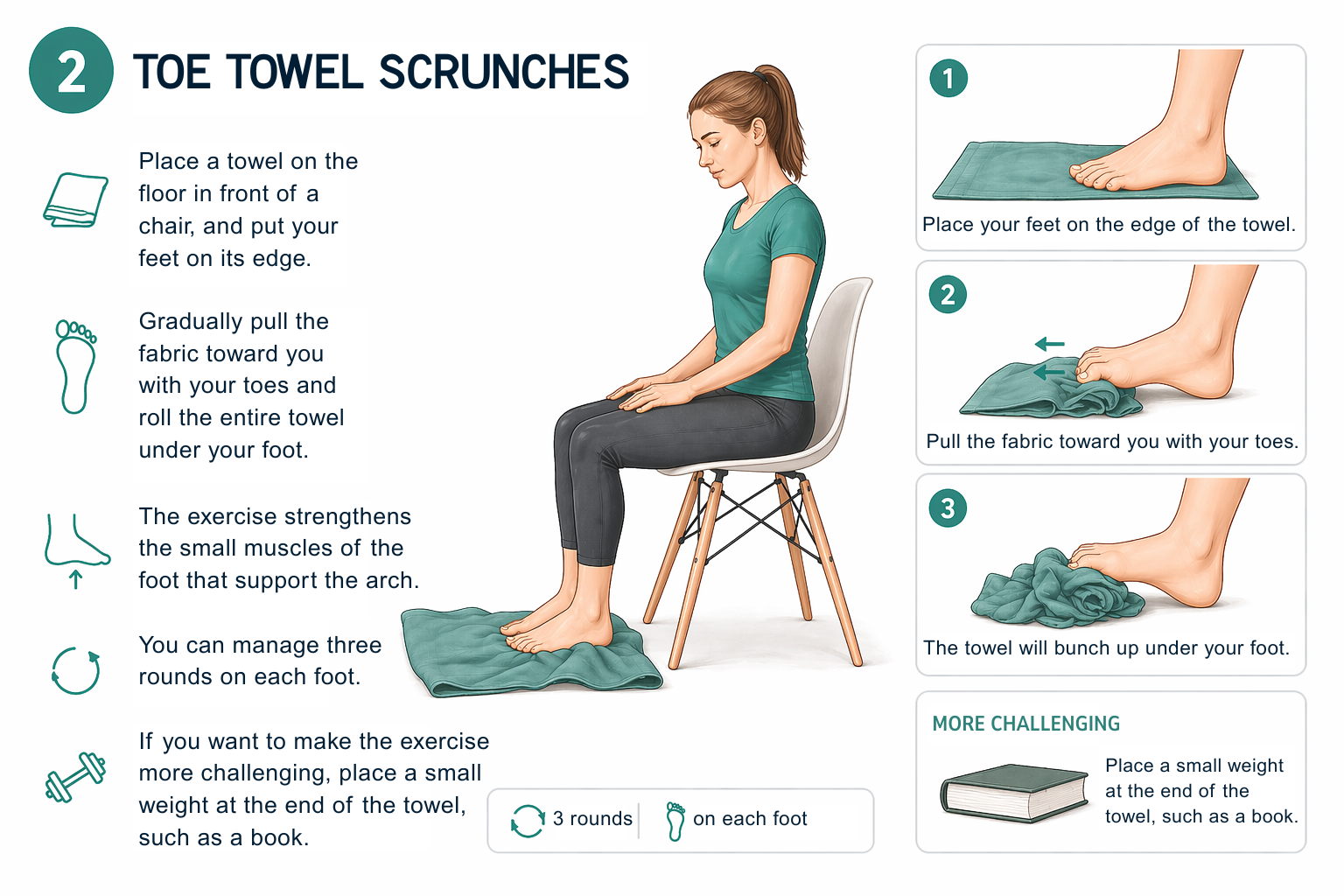
A classic physiotherapy exercise. Place a towel on the floor in front of a chair and rest your feet on its edge. Use your toes to gradually pull the fabric toward you, scrunching the entire towel under your foot. This exercise strengthens the small intrinsic muscles of the foot that support the arch. Aim for three rounds on each foot. To make the exercise more challenging, place a small weight—such as a book—at the far end of the towel.
3. Calf Raises
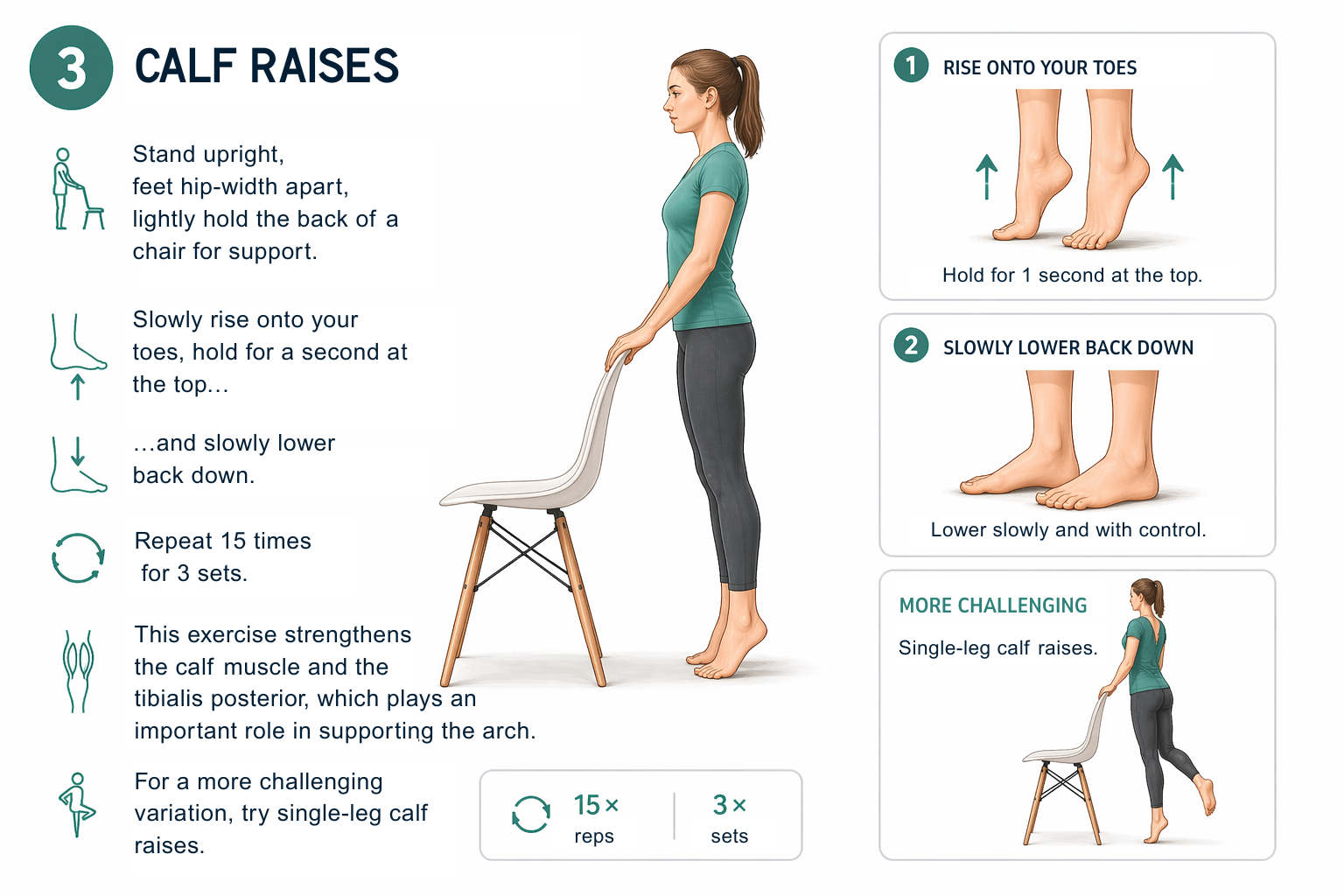
Stand upright with your feet hip-width apart, lightly holding the back of a chair for support. Slowly rise onto your toes, hold for a second at the top, then lower back down in a controlled manner. Repeat 15 times for three sets.
This exercise strengthens the calf muscles and the tibialis posterior, which plays an important role in maintaining the longitudinal arch. For a more challenging variation, try performing the raises on one leg.
4. Ball Massage for the Sole
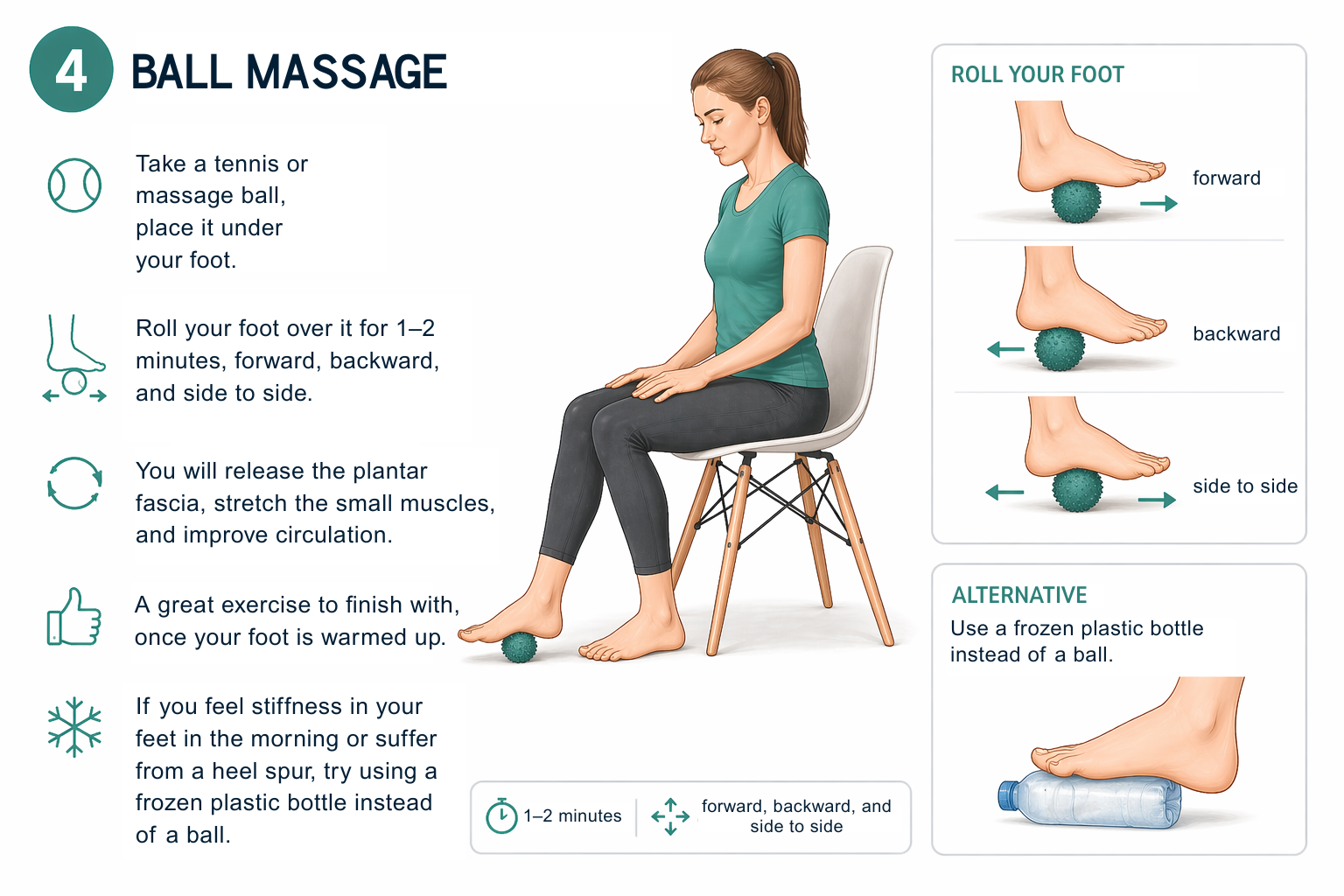
Take a tennis ball or a massage ball (spiky ball), place it under your foot, and roll it back and forth as well as side to side for one to two minutes. This helps release the plantar fascia, stretch the small muscles, and improve circulation.
It’s a great exercise to finish with, once your feet are warmed up. If you feel stiffness in your feet in the morning or struggle with a heel spur, try using a frozen plastic bottle instead of a ball.
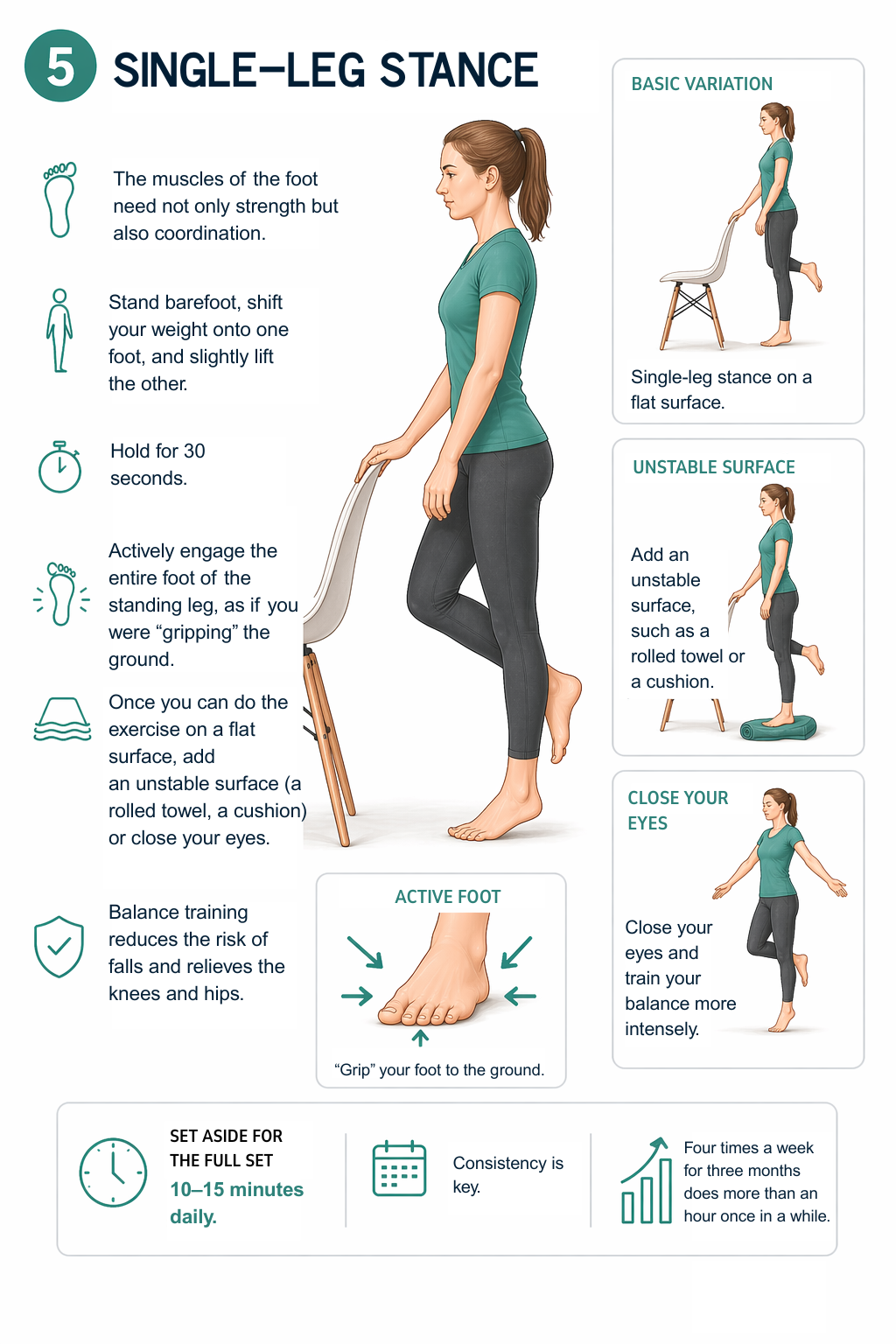
5. Single-Leg Stance
The muscles of the foot need not only strength, but also coordination. Stand barefoot, shift your weight onto one leg, and slightly lift the other. Hold for 30 seconds. Actively engage the entire foot of the standing leg, as if you were “gripping” the ground.
Once you can perform the exercise on a flat surface, add an unstable base (such as a rolled towel or cushion) or close your eyes. By training your balance, you can reduce the risk of falls and relieve stress on the knees and hips.
Set aside 10 to 15 minutes a day for the full routine. Consistency is key. Four sessions a week over three months will bring better results than an occasional one-hour workout.
What Else Can Help Besides Exercise
Podoscope Assessment
Before you start exercising on your own, it’s worth finding out what exactly is going on with your feet. A podoscope is a glass platform with polarized lighting that you stand on. A physiotherapist or podiatrist can observe the imprint of your foot from below and assess heel alignment, forefoot loading, and overall posture. The assessment is quick, painless, and provides an answer to a key question—whether you have flexible or structural flatfoot. Based on the results, you can then choose the appropriate treatment with a specialist.
Barefoot Walking on Uneven Surfaces
The foot becomes more active where it is challenged to work. Walking on grass, sand, pebbles, or forest roots provides exactly the kind of stimulation it needs. However, don’t overdo barefoot walking on hard, flat indoor surfaces—learn more in our article Walking barefoot: Is it really that good for you?
Proper Footwear
Choose shoes with a firm heel counter, a sufficiently wide toe box, and a heel height of up to four centimeters. Narrow high heels or wearing ballet flats all day can place long-term strain on the arch. If possible, consider trying barefoot shoes with a wide toe box, which allow the toes to move freely.
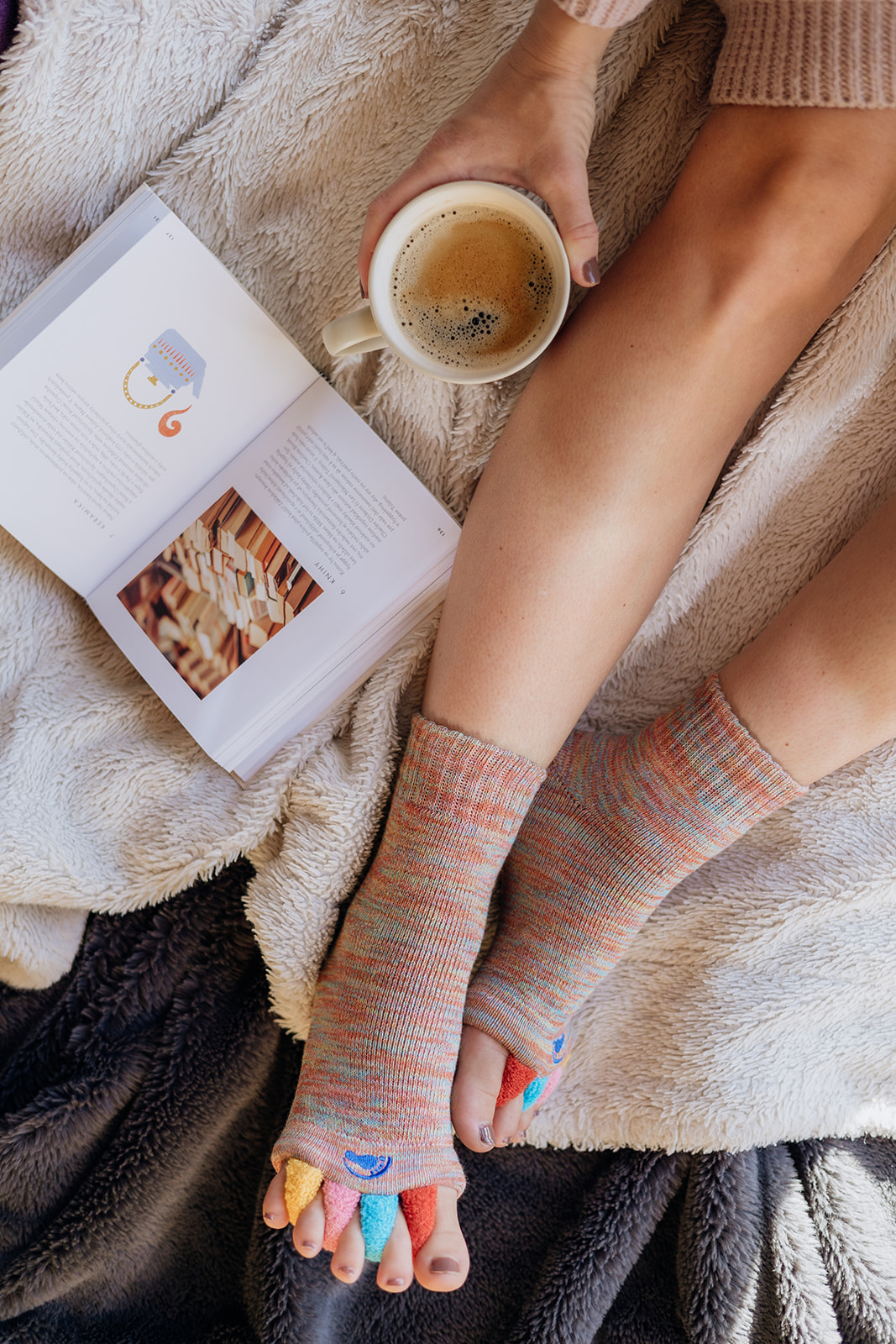
Foot Alignment Socks
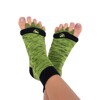
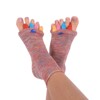
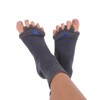
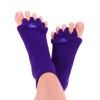
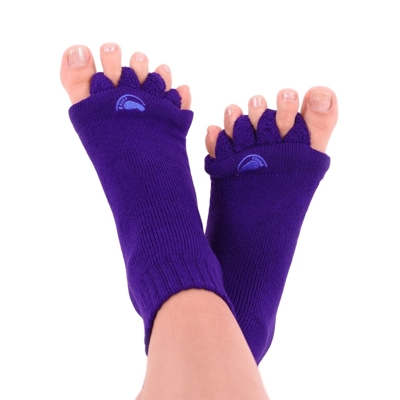
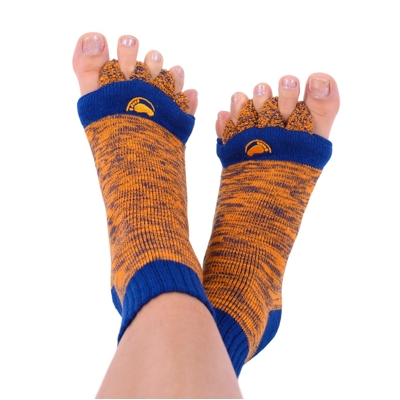
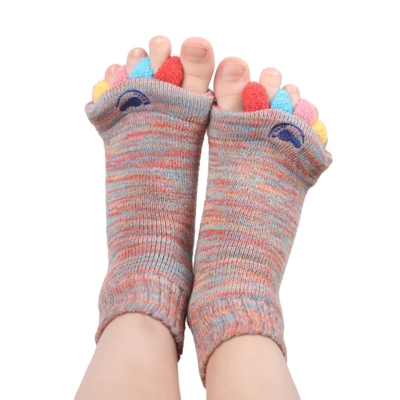
Foot Alignment Socks can be a great complement to therapy. The toe separators help release tension in the foot, improve circulation, and support the toes in returning to a more natural position. They won’t correct flat feet or lift the arch on their own, but they work very well alongside exercises and physiotherapy—especially if you experience pain, swelling, or tension in the forefoot (see more in our article Healthy Feet Without the Gym).
Wear them while resting, such as when sitting or sleeping, and never inside shoes.
When to See a Specialist
If foot, back, or knee pain is limiting your daily life, exercise alone may not be enough. Consider booking an appointment with a physiotherapist or podiatrist. A specialist can teach you the correct technique, design an individualized approach, and, if needed, recommend orthotic insoles.
As the saying goes, the sooner you start, the better. Flexible flatfoot responds well to exercise, while with structural deformities in adulthood, the arch cannot be fully restored. However, exercise can help maintain function and reduce pain.
Sources:
Huang C. et al. Effects of the Short-Foot Exercise on Foot Alignment and Muscle Hypertrophy in Flatfoot Individuals: A Meta-Analysis. Int. J. Environ. Res. Public Health, 2022. mdpi.com/1660-4601/19/19/11994
Moon D., Jung J. et al. Effect of Incorporating Short-Foot Exercises in the Balance Rehabilitation of Flat Foot: A Randomized Controlled Trial. Healthcare, 2021. pubmed.ncbi.nlm.nih.gov/34683038
Hara S., Kitano M., Kudo S. The effects of short foot exercises to treat flat foot deformity: A systematic review. Journal of Back and Musculoskeletal Rehabilitation, 2023.
Sulowska-Daszyk I., Mika A. A comprehensive exercise program improves foot alignment in people with flexible flat foot: a randomised trial. Journal of Physiotherapy, 2022.